
Ethereum’s Next Evolution: How EIP 8141 Makes Smart Wallets Native
Vitalik Buterin’s EIP 8141 proposal integrates account abstraction at the protocol level, simplifying validation, removing bundlers, and unlocking features such as token-based gas fees and customizable wallet logic.
TECHNOLOGYCRYPTOCURRENCY
ThingamaGeorge
3/10/20261 min read
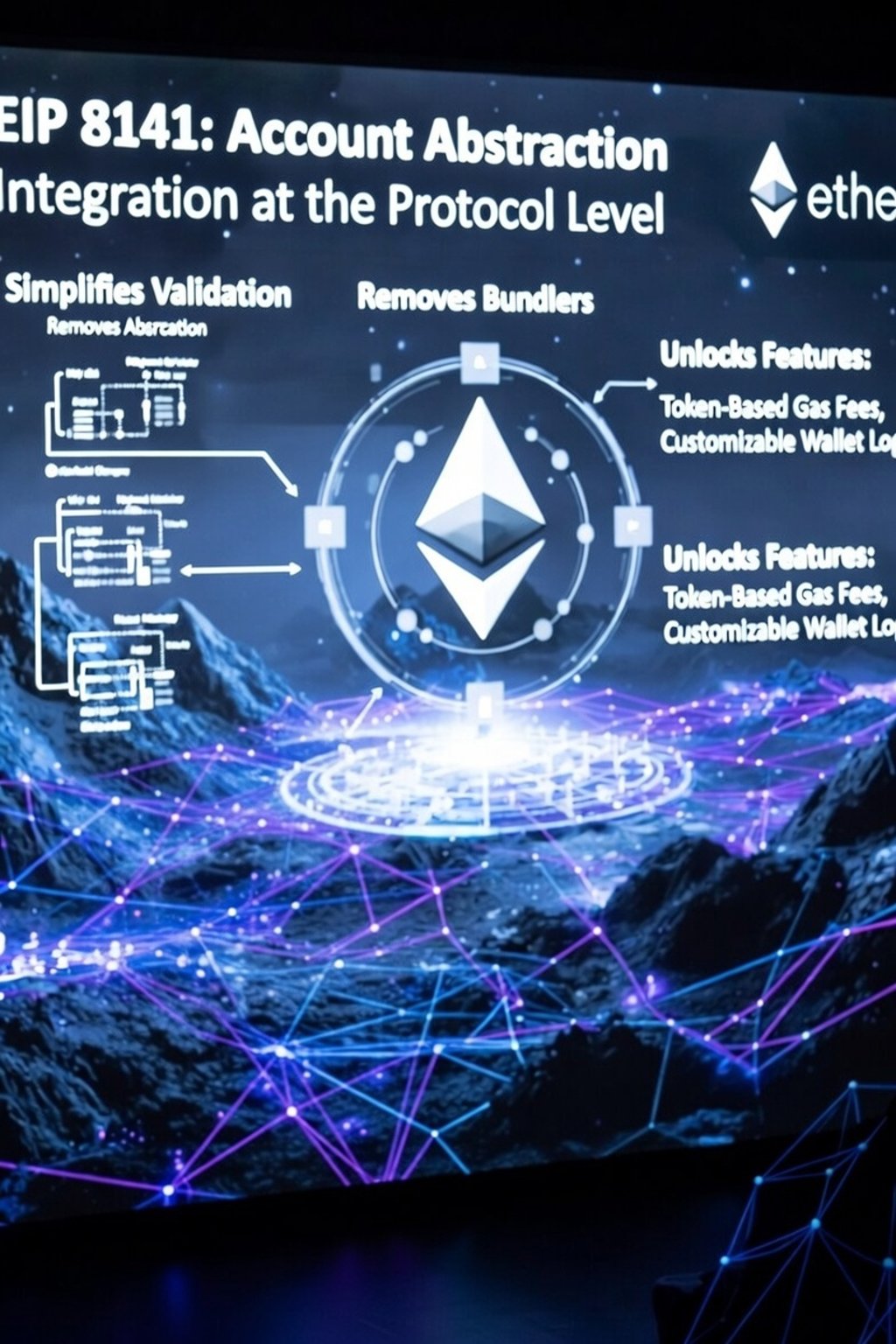
EIP‑8141 Proposes
Brings native account abstraction directly into Ethereum’s base protocol.
Introduces Frame Transactions, which move validation, gas logic, and execution into the protocol itself.
Eliminates reliance on external infrastructure like bundlers and the EntryPoint contract used in ERC‑4337.
Does This Matter
Existing Ethereum addresses remain valid — no need to migrate or change wallets.
Hardware wallets gain clearer, structured signing (users sign “Frames” instead of opaque hex).
Gas payments become flexible — users can pay fees in ERC‑20 tokens via Payment Frames.
Makes Ethereum wallets programmable by default, enabling:
Social recovery
Custom signature schemes
Transaction batching
Automated or conditional execution
Background
Account abstraction has been discussed since 2016.
ERC‑4337 (2023) enabled abstraction without protocol changes, but required:
A separate mempool
Bundlers
The EntryPoint contract
EIP‑8141 integrates abstraction natively, simplifying architecture and reducing operational overhead.
The Shift
Frame Transactions break actions into modular steps:
Validation
Gas authorization
Execution
Optional deployment
This replaces the monolithic EntryPoint model and allows deeper optimization.
Timeline
EIP‑8141 is expected to roll out with the Hegota fork in late 2026.
Major client teams (Geth, Erigon, Nimbus) have expressed support.
Testing focuses on:
Backward compatibility
Deterministic behavior across clients
Gas accounting stability
Security against new attack vectors
Ecosystem Impact
Enables native multi-party authorization, role-based permissions, and automated policy enforcement.
Reduces reliance on complex smart‑wallet wrappers.
Improves auditability and reduces operational risk for exchanges and custodians.
After nearly a decade of research, EIP‑8141 represents the first proposal to embed account abstraction directly into Ethereum’s consensus rules. If adopted, it transforms programmable accounts from an optional layer (ERC‑4337) into a core protocol feature, reshaping how every user and institution interacts with Ethereum.
Important Links
Socials
Blog Post Topics:
Copyright © 2019-2026 WebSpace4Rent, Inc. (WS4R) - All Rights Reserved. WebSpace4Rent.com
WebSpace4Rent, Inc. may earn an Affiliate Commission if you purchase something through recommended links on this webpage or in this article.